Problems That Computers Can Solve
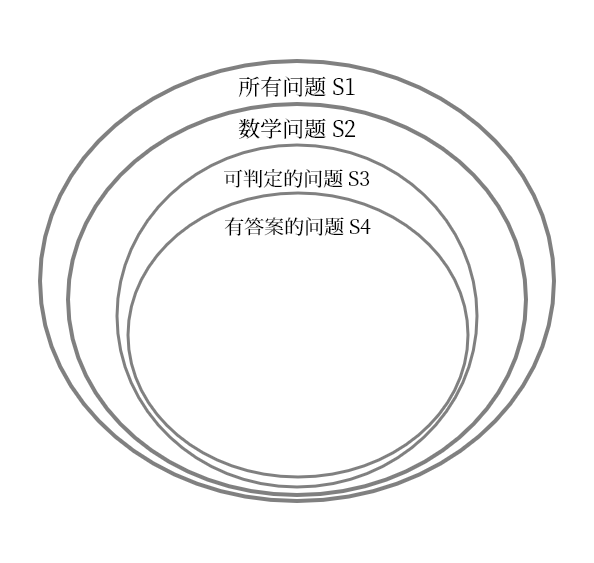
Does a Mathematical Problem Have an Answer?
In the 19th century, mathematician Hilbert pondered the following three questions:
- Is mathematics complete? Completeness means that for any proposition, it can either be proven true or proven false.
- Is mathematics consistent? Consistency means that a proposition cannot be both true and false.
- Is mathematics decidable? Decidability means that for a specific problem, can you determine whether it has an answer?
Hilbert's three questions essentially delineated the boundaries of mathematics. Mathematics can only solve problems that are mathematically complete, and the consistency of mathematics ensures that there are no seemingly plausible answers. Hilbert himself could not answer this question. Later, mathematician Gödel resolved the first two questions and proposed the Gödel's incompleteness theorem: mathematics cannot be both complete and consistent. Regarding the third question, Hilbert posed a more specific problem, known as Hilbert's tenth problem: for any number of unknowns in a polynomial equation with integer coefficients, provide a feasible algorithm that can determine, through a finite number of operations, whether the equation has integer solutions. Here are three examples:
This equation clearly has integer solutions, such as the Pythagorean triple 345.
This is a special case of Fermat's Last Theorem, which was proven to have no solutions by Wiles. Whether this problem has solutions or not is decidable, just like the previous one.
In 1970, Soviet mathematician Matiyasevich proved that for this equation, as well as for the vast majority of polynomial equations, we can neither prove that they have integer solutions nor prove that solutions do not exist.
Can Answers Be Found in Finite Steps?
In the mid-1930s, Turing began to contemplate the following three fundamental questions:
- Do all mathematical problems have clear answers?
- If there are clear answers, can they be obtained through finite steps of computation?
- For those mathematical problems that can potentially be computed in finite steps, can there be a hypothetical machine that continuously operates, and when it stops, the mathematical problem is solved?
In 1936, Turing did not know the answer to Hilbert's tenth problem, but he guessed the answer was negative. Thus, he answered the first two of his questions negatively: not all mathematical problems have clear answers, and even if there are clear answers, they cannot be obtained in finite steps. He then focused on problems for which answers could be found in finite steps. To this end, he designed a mathematical model to address his third question. This mathematical model is known as the Turing machine.
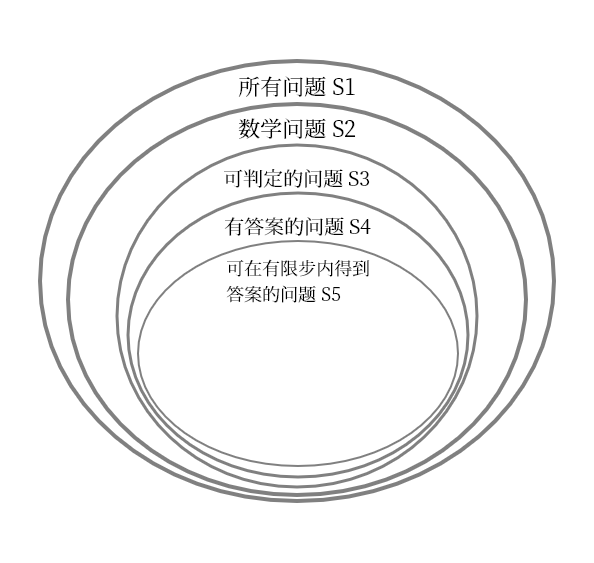
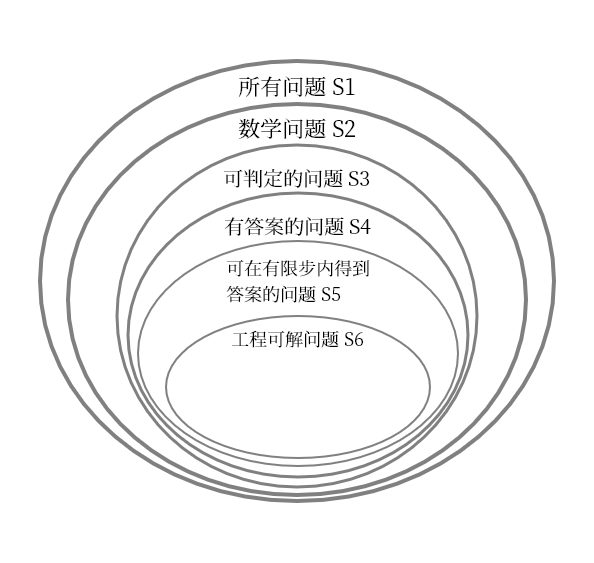
In the above diagram S5, finite steps are actually Turing's ideal hypothesis. Even if the computation time exceeds the age of the universe, it is still considered finite steps. For example, problems with computational complexity equal to or greater than exponential functions. Therefore, in engineering practice, the problems that can be solved, S6, are a subset of S5.
The Limits of Artificial Intelligence
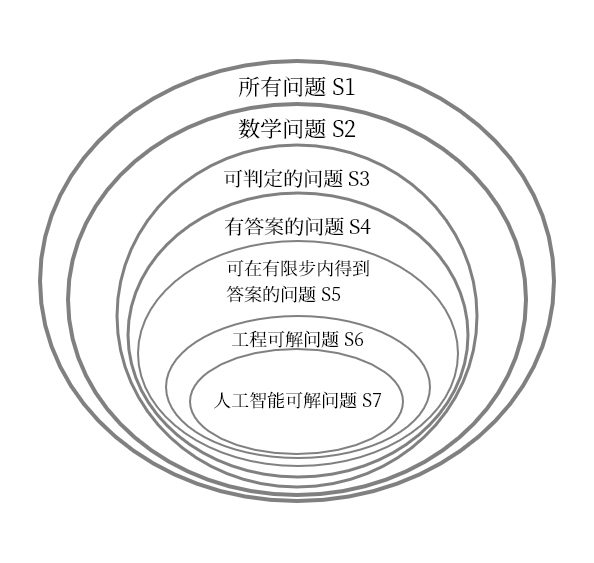
As long as artificial intelligence runs on computers, the problems it can solve are merely a subset S7 of the problems that are solvable in engineering. In recent years, artificial intelligence has appeared increasingly intelligent because people have discovered many ways to transform specific problems into mathematical problems, such as playing Go. The extension of S7 has expanded. However, S7 will never exceed S6.
Conclusion
Computers were originally invented to solve mathematical problems, and to this day, they can only solve the problems depicted in S6. No matter how fast the computer's processing speed is, it cannot reach S5. For instance, in 2018, Google announced that their quantum computer could break existing encryption algorithms, making it seem like our passwords were no longer secure, but in reality, simply doubling the length of the password would require a trillion times more computational effort to break it.
There may exist machines that can solve non-mathematical problems, but they are not the computers we are discussing today. The so-called artificial intelligence can only solve problems that belong to S7.
Buffett and Munger like to talk about the ability circle; as individuals, one should recognize their own boundaries of capability, as Confucius said, "At fifty, I knew my destiny." Anything beyond theoretical boundaries is illusory.